
Crypto ATM Scams: Real Cases Show How a Phone Call Ends at a Bitcoin Kiosk
Global Anti-Scam Centre | November 2026
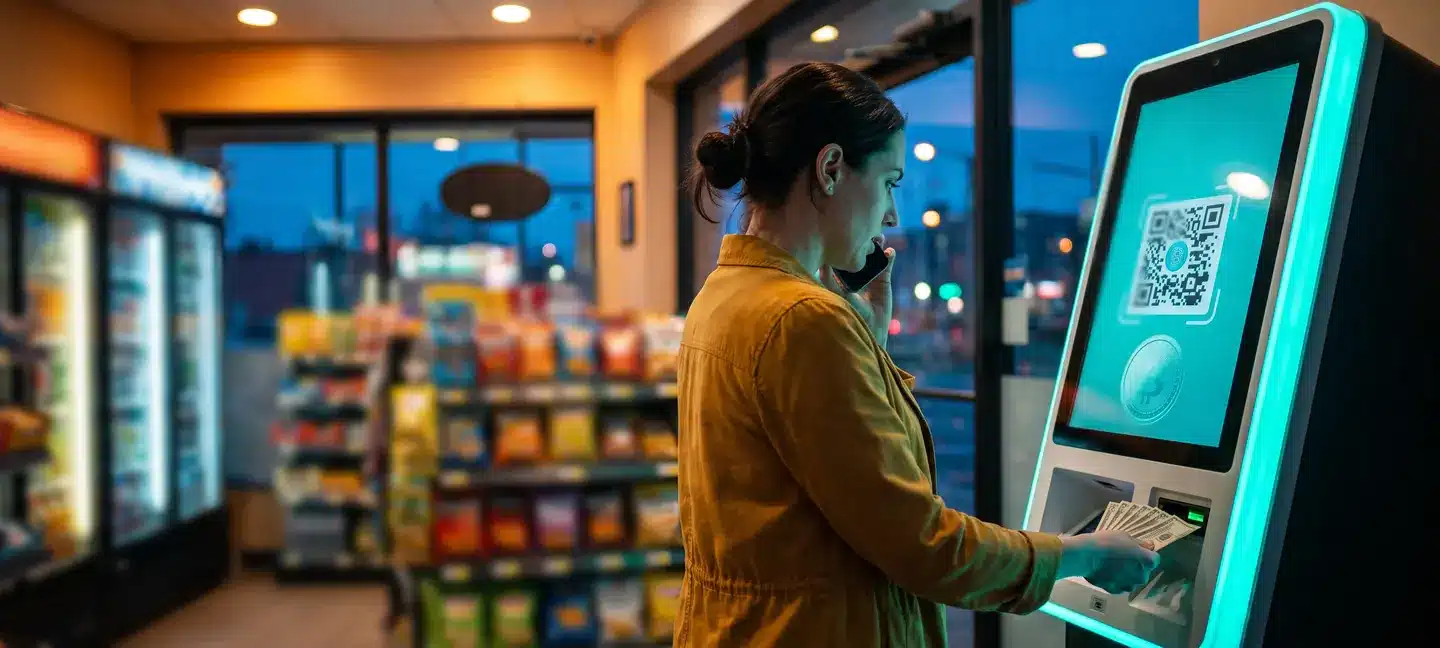
A crypto ATM looks like an ordinary cash machine in a convenience store or petrol station. For scammers, it is one of the fastest ways to turn a victim’s cash into cryptocurrency that lands in a wallet they control. Recent cases and warnings from the United States and Australia show the same pattern again and again: an unexpected call or message, a story built on fear or opportunity, and an instruction to feed cash into a kiosk while the caller stays on the line.
Springfield, Massachusetts: nearly 60 victims and a proposed ban
On 12 November 2026, police in Springfield, Massachusetts, told a city council subcommittee that at least US$1.4 million had been taken from nearly 60 victims, much of it through cryptocurrency ATMs in local stores. Since early 2024, callers posing as law enforcement had persuaded people to travel to the city and deposit cash into a digital “wallet” through the machines, some after being told they could be arrested if they did not pay. One scam even involved someone impersonating the city’s police commissioner.
A detective told councillors that many cases go unreported because people are embarrassed, and that some victims had lost their life savings. Many were over 60. City leaders have now filed an ordinance to ban the machines within city limits, as about 20 other Massachusetts communities have done.
Source: WAMC Northeast Public Radio, 16 November 2026
Pennsylvania: fake warrants, fake romance and fake profits
On 29 October 2026, Pennsylvania’s Attorney General launched a STOP sign campaign to place warnings on crypto ATMs across the state. His office said it received about 290 cryptocurrency scam complaints the previous year, most commonly involving investment or romance approaches, and that government impostor calls from people posing as county sheriff’s offices have increased. In one case, a caller who appeared to be from a local police department said there was an outstanding warrant and ordered the person to buy US$4,000 in cryptocurrency at a kiosk, which was then sent to the scammer.
Another case started with a relationship on WhatsApp. The person reported sending US$81,000 for supposed cryptocurrency investments “for their future together”, and only realised it was a scam when they could not withdraw without paying more. The office warned that caller ID can be manipulated to show a legitimate number, and that fraudulent platforms may display fake earnings, then block withdrawals or demand “taxes” or fees.
Source: Pennsylvania Office of Attorney General, 29 October 2026
California: an operator ordered to compensate victims
On 4 November 2026, California’s Department of Financial Protection and Innovation ordered CoinFlip, which operates roughly 500 kiosks in the state, to pay more than US$4.8 million to California victims and over US$350,000 in excessive fees. The regulator found that, since 2021, the company had failed to properly identify its users and to detect and report suspicious activity.
Source: DFPI, 4 November 2026
Australia: limits, warnings and a suspended operator
Australia has seen the same risks. AUSTRAC says crypto ATMs are especially vulnerable to abuse because they convert cash to cryptocurrency quickly, and that many users are aged over 50, a group more likely to be targeted by scams. Since 2025, operators have had to apply a A$5,000 limit on cash deposits and withdrawals, display mandatory scam warnings and carry out enhanced customer checks. In August 2026, AUSTRAC suspended the registration of one operator, Cryptolink, taking its 96 machines offline over compliance concerns. AUSTRAC also warns that anyone asked to buy cryptocurrency for someone else may be moving criminal proceeds; in one case it described, a man was duped into converting close to A$200,000 of criminal proceeds into cryptocurrency.
Sources: AUSTRAC: Cryptocurrency ATM scams; AUSTRAC: Crypto ATM providers to meet minimum standards; AUSTRAC, 10 August 2026
The size of the problem
According to the US Commodity Futures Trading Commission, citing the FBI’s Internet Crime Complaint Center, scams involving crypto ATMs led to more than US$388 million in reported losses in 2025, a 58 per cent increase on the year before, and actual losses may be higher because of under-reporting. Fake trading platforms, fraudulent apps, gift cards and couriers are used for the same reason: they hide who receives the money.
Source: CFTC: Pause Before You Pay
Lessons from these cases: the red flags
- Anyone who tells you to pay at a crypto ATM. Police, courts, government agencies and genuine companies do not ask for fines, bail, taxes or “protection” payments through a crypto kiosk.
- A QR code or wallet address supplied by someone else. If you did not create the wallet yourself, you do not control the money you send to it.
- A caller who stays on the line, tells you what to say to shop staff, asks you to split payments or insists on secrecy.
- An online friend or partner who moves the conversation to investing, or a platform that shows large profits but demands fees before a withdrawal. Read our account of a pig butchering scam that began with a wrong-number text.
- A number that cannot be tied to a verified office. Caller ID can be spoofed, and a hosted or VoIP number not tied to a verified registered office is a risk indicator.
Check a firm before you invest
If someone is urging you to invest through crypto, check the firm independently, using contact details you find yourself rather than those you were given: in Australia, ASIC’s professional registers and the Moneysmart Investor Alert List; in the United States, Investor.gov; internationally, the IOSCO I-SCAN warnings database. Our guide on how to check an investment platform before you invest explains each step. For an independent opinion, GASC Verify provides a human-reviewed pre-investment check of a platform, company or phone number for US$199.
If you have already paid at a crypto ATM
Stop sending money and end contact with the caller. Keep your kiosk receipts, the QR code or wallet address you were given, screenshots of messages and call logs, and the times and locations of each deposit. Report the matter to the fraud reporting body in your country, and tell the kiosk operator as soon as possible. Expect follow-up approaches: people who offer to get your money back for an upfront fee are often running recovery scams. Our guide on what to do after losing money to a crypto scam sets out the next steps.
GASC Investigator’s Assessment
In our assessment, the recent cases from Springfield, Pennsylvania, California and Australia show that a crypto ATM is rarely the start of the scam; it is the cash-out step. The approach is usually a call or a message that creates fear or a sense of opportunity, then an instruction to feed cash into a kiosk, often while the caller stays on the line. Springfield police described callers posing as law enforcement; Pennsylvania’s Attorney General reported both government-impostor calls and romance-investment approaches that ended at a machine. AUSTRAC makes the same point about speed: once cash has been converted, it is much harder to follow.
Anyone who tells you to pay a fine, tax, bail or investment at a crypto kiosk should be treated as a warning sign, whatever appears on the caller ID. A hosted or VoIP number that is not tied to a verified registered office is a further risk indicator. Some of these approaches begin as relationship investment scams, as in the pig-butchering case we described earlier. If you have already paid at a machine, stop sending money, keep the kiosk receipts and the wallet address you were given, and be wary of a follow-up offer to recover the funds. Request a confidential case assessment if you want our experienced investigators to review what happened and tell you whether further work may be viable.
Where GASC fits
Global Anti-Scam Centre is an independent private investigation organisation. Our experienced investigators include former law enforcement detectives, former government intelligence professionals and experienced private-sector investigators, with international experience running investigations alongside local law enforcement. We look at what happened, who was behind the scheme and where the money went, and we tell you honestly whether an investigation may be viable. We never contact people first offering to recover funds, and we do not guarantee outcomes. Learn more about our cryptocurrency fraud investigations.
Request a Confidential Case Assessment
Verify us
Global Anti-Scam Centre (GASC) is an independent private organisation headquartered in Australia. We are not a government agency, regulator or law-enforcement body, and we are not connected with Scamwatch, the National Anti-Scam Centre (NASC) or the Global Anti-Scam Alliance (GASA). We will never contact you first offering to recover funds, and we cannot guarantee any particular outcome.
Latest Media Insights


